
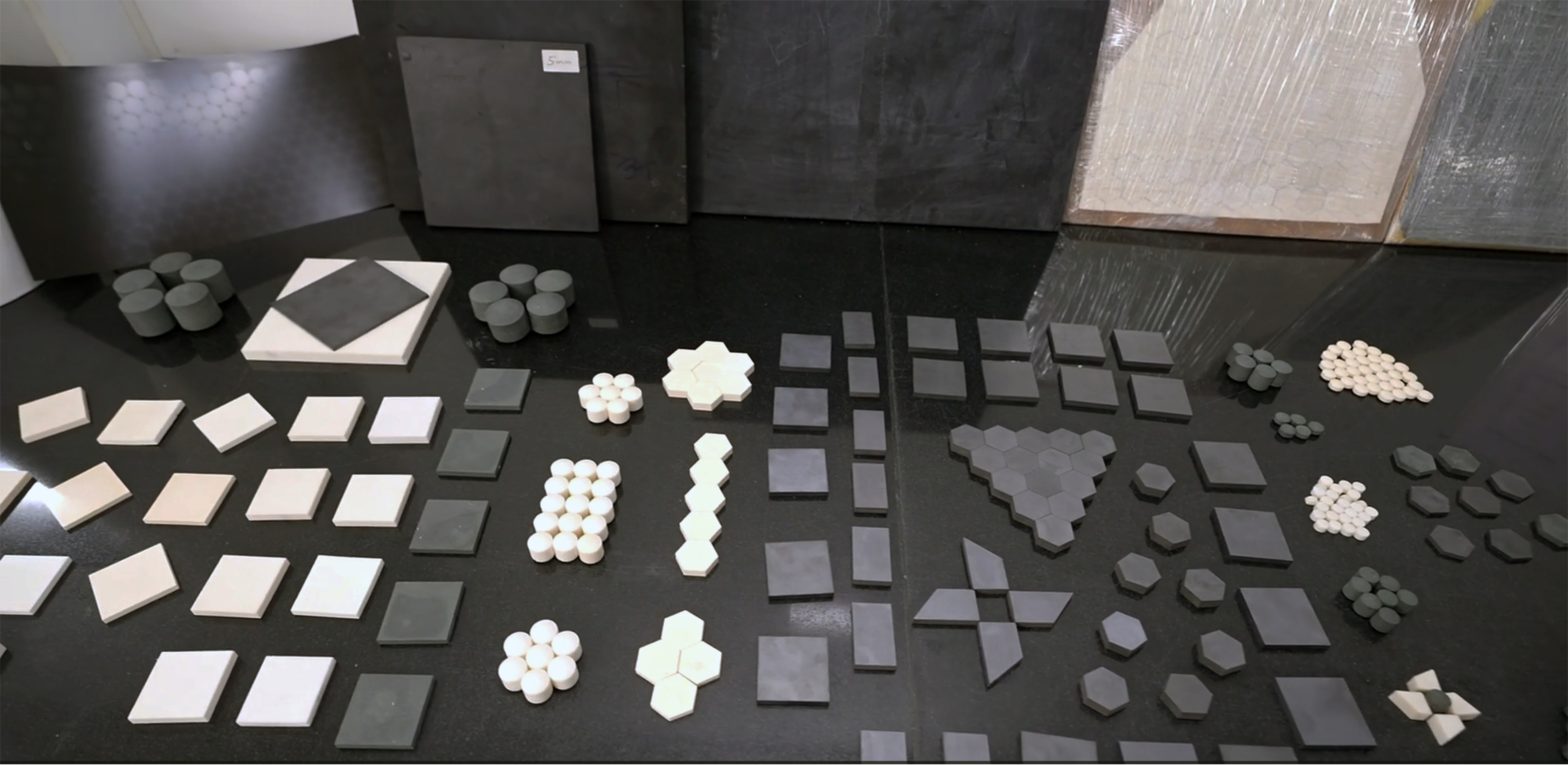
With 10 armour ceramics qualifications from leading certification agencies, CUMI is enabling defence OEMs to design and innovate at speed for our soldiers.
In the relentless pursuit of defence modernisation, India is set to spend $543.1 billion in the next few years to sharpen its military edge and mitigate the risk of cross-border threats. This means integrating next-gen platforms, sophisticated sensors, and future-ready systems. Yet, at the very core of this transformation lies a more fundamental, life-preserving imperative: the assurance of absolute protection.
True modernisation is not just about enhanced firepower, but about guaranteeing the survivability of the combat pilot in the cockpit and the soldier on the field. Recognising this, India is pushing to arm its forces with the best in protective tech. This is clearly reflected in expected growth forecasts, with India’s CAGR leading the body armour market at 7% from 2025 to 2035.
However, this definitive guarantee of advanced protection is strongly tied to a commitment to benchmark and qualify materials as per the most exacting standards. The process – a tough, robust, challenging one where every component of protective armour, right from the materials, is tested, certified, and proven to meet the world’s most stringent benchmarks.
How materials qualification is directly linked to soldier safety
The modern battlefield presents a complex matrix of threats, from high-velocity armour-piercing rounds to improvised explosive devices (IEDs). Traditional materials have proven inadequate against this evolving spectrum. This has created an urgent need for advanced material solutions that are both lightweight and impenetrably strong. Engineered ceramics, such as Reaction Bonded Silicon Carbide (RBSiC) and Zirconia Toughened Alumina (ZTA), have revolutionised the definition of protection in defence.
Used as tiles along with appropriate backing material, they work by shattering incoming projectiles on impact, dissipating kinetic energy, and preventing any kind of injury to the soldier. The biggest advantage with these materials is that a ceramic composite panel weighs just one-third of a traditional metal equivalent. This helps it strike an effective balance between protection and the speed & agility essential for mission success and survival.
Also read: Global Protection Standards: A Significant Step in India’s Journey to Defence Modernisation
The high-stakes behind testing & validation in defence
Testing & qualification is a tough and demanding phase for defence manufacturers. Challenges can range from multiple rounds of retesting (at limited test facilities with long wait times), component redesign, delay in delivery, cost overruns, supply uncertainty, and potential loss of credibility with the Armed Forces and government procurement agencies.
This is precisely where CUMI has stepped in to make the process easier.
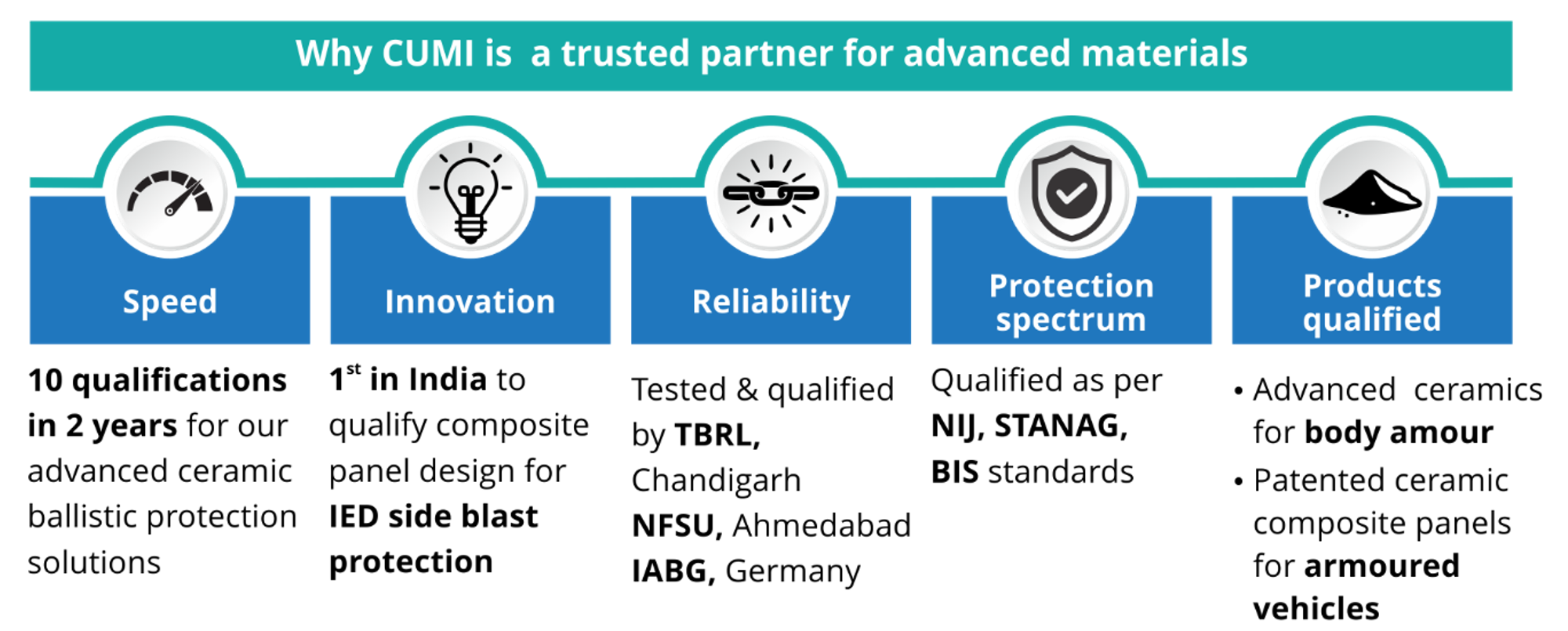
With 10 armour ceramics qualifications, we are India’s first advanced materials manufacturer to offer world-class advanced ceramics and composite armour solutions for personal protection and armoured vehicles, covering multiple threat levels—including STANAG 4569 IED side blast protection.
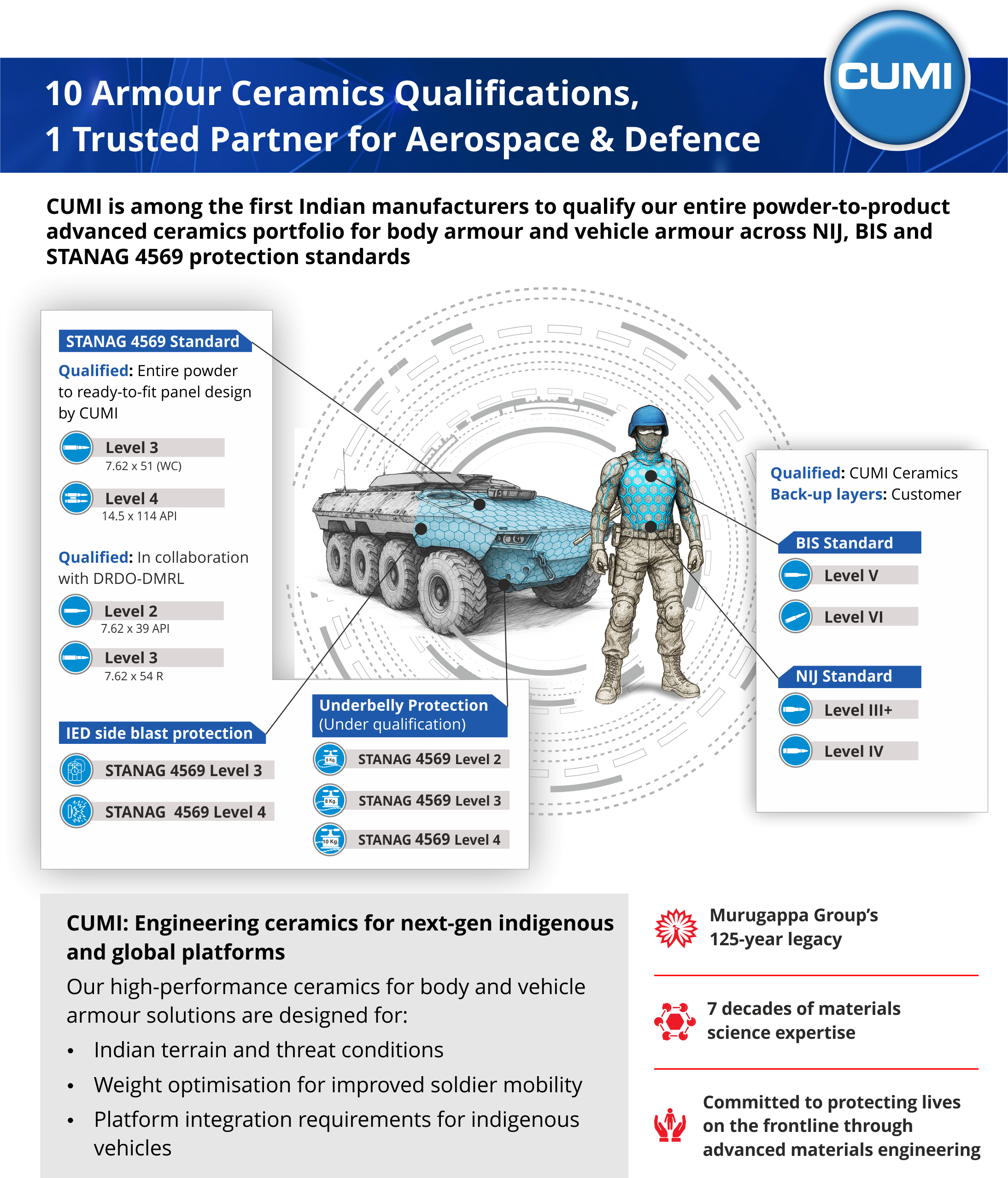
These qualifications directly support the Ministry of Defence’s modernisation efforts for the Indian Army, Central Armed Police Forces (CAPFs), and indigenous armoured vehicle platform development programs, reducing dependence on imports and shortening deployment timelines.
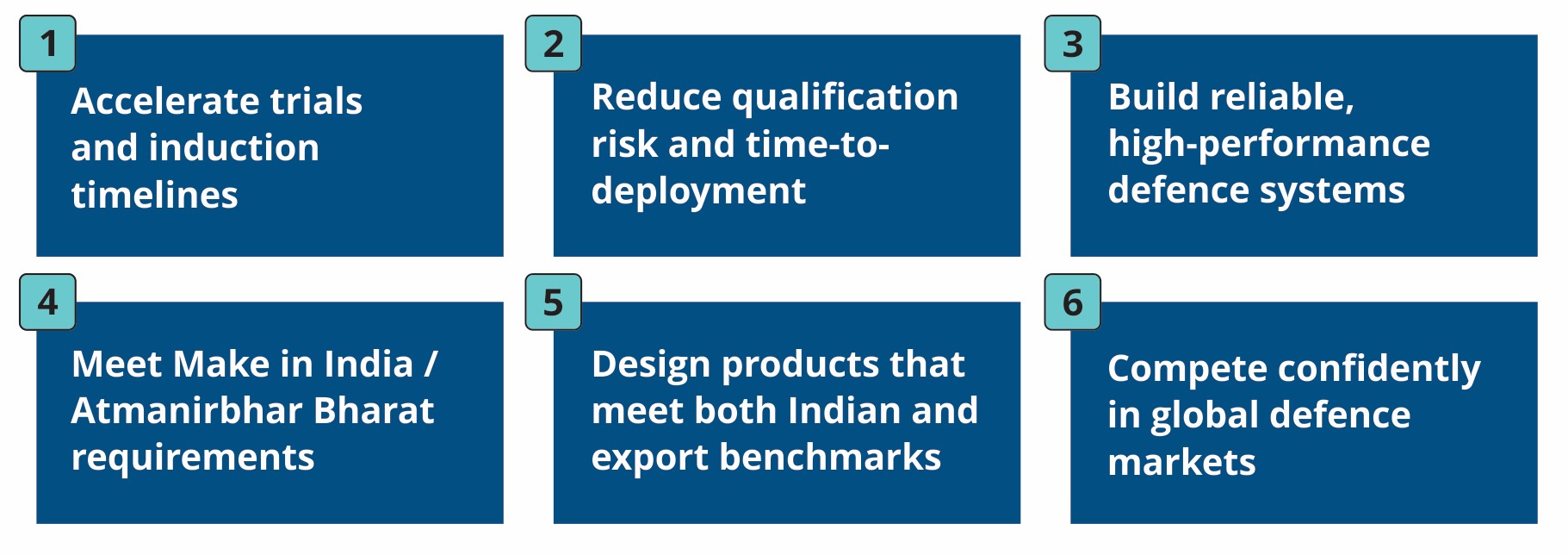
By delivering an already-qualified powder-to-product range for armour, our end-to-end approach enables you as an OEM / system integrator to:
With our world-class manufacturing capabilities spanning grains & powders, advanced ceramics, and ceramic composite armour panels, you can count on us to be your trusted, single-source partner for all your armour ceramics requirements.
The CUMI edge: Qualified powder to ready-to-fit armour ceramics
CUMI’s unique authority in this domain stems from a legacy of expertise spanning 7 decades and being completely backward integrated in our operations. Our powder-to-product manufacturing model means we are involved right from the beginning of the defence materials supply chain.
Unlike companies that assemble components, CUMI’s journey begins with the raw materials themselves. This means we have complete control over raw material supply, quality, and processing. A good example is our RBSiC ceramics for vehicle armour where the entire powder to ready-to-fit panel design is by our in-house R&D team. We have received the STANAG 4569 Level 4 qualification for this panel. In October 2025, we received the STANAG 4569 certification for protection Level 2 and Level 3 from IABG, Germany for our patented ZTA-based composite armour panels. This has been developed through the Transfer of Technology (ToT) route with DRDO’s Defence Metallurgical Research Laboratory (DMRL).
In the current scenario of intense global conflict, backward integration has become central for national security. It ensures a resilient, secure, locally-sourced supply of defence-critical materials, insulating India from geopolitical supply chain disruptions. This capability is actively deployed in flagship national projects, most notably the indigenously designed Wheeled Armoured Platform (WhAP) 8×8. CUMI, in partnership with DMRL, will deliver up to 300 unique, contour-fitting elastomeric ceramic panels for each WhAP vehicle, providing all-round ballistic protection, while ensuring the armoured vehicle is lightweight for quick deployment.
Read more: IABG Germany Certifies CUMI’s Ceramic Composite Panels for Vehicle Armour
Engineering for the future, with no room for error
The intention behind constantly evolving and testing defence protection systems is clear. They should capably defend those safeguarding our frontiers against every kind of threat conceived. Since it directly involves lives, there can be no room for error.
Also, the recent surge in innovations for defence and integration of new-age tech will take on a new dimension when materials and components are qualified. This will be seen in terms of faster induction timelines, easier convergence with emergent tech, highly reliable quality for long-term asset use, and distinct competitive advantage in export markets.
At CUMI, our focus on expanding our range of certified materials is not just a tangible contribution to India’s strategic goals. It is to ensure our soldiers have access to the latest and best in protection.
By enabling OEMs to develop lightweight, globally benchmarked armour, our efforts directly support soldier agility and survivability, as well as peak performance – key force multipliers in modern warfare. Further, by substituting costly imports with indigenously manufactured solutions, we are strengthening and accelerating India’s journey towards ‘Atmanirbharta’ in defence.
To support upcoming Indian defence programs, we are expanding high-end ceramic armour production capacity in 2026.
Ultimately, every qualified ceramic tile and every certified vehicle armour panel reinforces our core objective at CUMI: to save maximum lives on the frontline.
Frequently Asked Questions (FAQs)
STANAG 4569 and NIJ are globally recognised benchmarks for ballistic protection of combat vehicles and soldiers, respectively. Certification in line with these standards by labs in India such as TBRL and NFSU, and independent, accredited global agencies such as IABG, Germany provides scientific, third-party proof that the armour will perform as required against a range of battlefield threats.
Advanced ceramics such as RBSiC and ZTA offer exceptional hardness to shatter projectiles while being significantly lighter than steel. This weight reduction directly enhances a soldier’s mobility and endurance and improves a vehicle’s speed, fuel efficiency, and agility in complex terrains. The ability to customise tiles and panels ensures improved ergonomics to ensure high wearable comfort for soldiers, and precision in protection for armoured vehicles, especially in areas vulnerable to breach such as the sides and underbelly.
It means CUMI is the among the first Indian manufacturers to have qualified as per the STANAG 4569 Level 3 and Level 4 standards for IED side blast protection. Moreover, we are also the first to qualify our powder-to-product advanced ceramics portfolio across the complete spectrum of protection levels, from body armour (NIJ III to IV) to vehicle armour (STANAG 2 to 4, including IED side blast).
Being involved right from the start of the defence production chain, from raw materials (grains and powders) to the finished panel, ensures secure, captive materials supply, strict quality control / assurance, and cost-effectiveness. This vertical integration is vital for Indian defence to turn self-reliant, reducing critical dependence on foreign imports of advanced materials. Moreover, it ensures that defence OEMs now have a trusted partner in India whom they can rely on for easy supply fulfilment of qualified advanced materials and components.
Yes. A prime example is through the Transfer of Technology from DRDO-DMRL, where CUMI manufactures lightweight, add-on composite armour panels for the indigenously developed Wheeled Armoured Platform (WhAP) 8×8, providing it with certified ballistic protection.
