

A familiar sight at major international airports such as Delhi’s Indira Gandhi International Airport in New Delhi or Bengaluru’s Kempegowda International Airport is of security personnel stationed behind transparent guard cabins, reinforced shields, and protective barriers. A critical aspect of India’s security infrastructure, these stationary armour systems form the ‘first line of defence’ against potential threats.
Similar systems are deployed at sensitive border checkpoints across Jammu and Kashmir and along installations guarded by forces such as the Central Industrial Security Force and the Border Security Force. These fixed protective systems, ranging from soldier-operated ballistic shields to fortified sentry posts and modular ballistic walls, provide critical ballistic protection to military and paramilitary personnel operating in highly exposed environments where exposure to small-arms fire and ballistic threats is a constant risk.
Stationary armour systems: A story of rising demand and rapid advancements
Stationary armour solutions form part of the broader ballistic protection ecosystem, which includes body armour, helmets, ballistic shields, and protective infrastructure systems. Globally, this market is projected to grow from $16.2 billion in 2025 to nearly $27.9 billion by 2035, reflecting rising investments in force-protection technologies across the defence and law-enforcement sectors. In India, it is being driven largely by defence modernisation initiatives and the increasing need for advanced protection solutions for armed forces and paramilitary units.
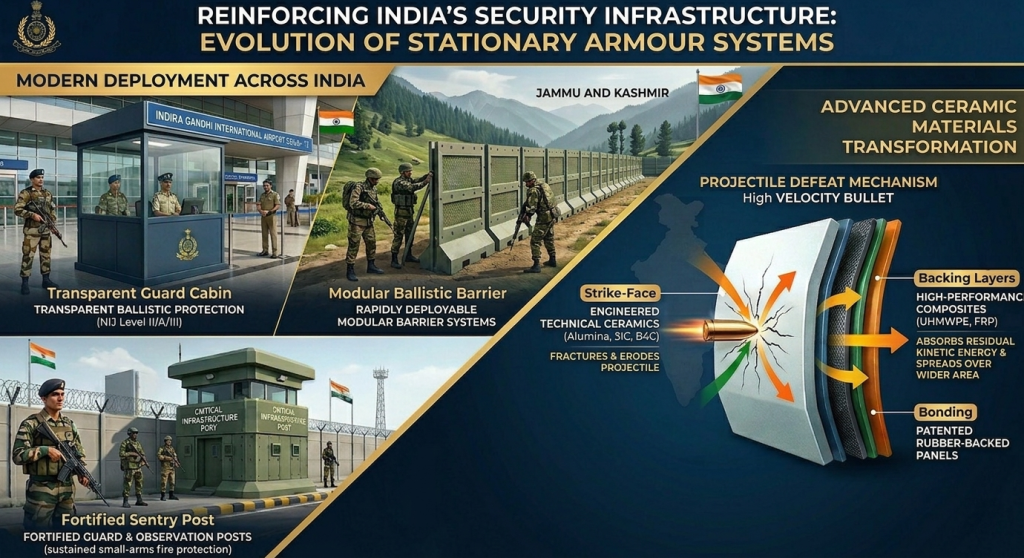
With governments fortifying security infrastructure at airports, borders, and critical installations, the demand for stationary armour systems is expected to rise. As India strengthens border security and urban counter-terror preparedness, significant advances in materials science are enabling new generations of stationary armour systems to combine higher ballistic resistance with reduced weight for improved mobility and greater operational resilience.
Also read: CUMI’s whitepaper on Redefining Protection for Man & Machine
Understanding stationary armour systems and their operational roles
Stationary armour systems are protective structures or equipment designed to shield personnel operating from fixed or semi-fixed positions. Unlike vehicle armour or wearable protection systems, these solutions are integrated into security infrastructure, forming a defensive barrier between personnel and ballistic threats.
In defence, stationary armour systems can be broadly classified according to their operational deployment roles.
Tactical shield systems: Tactical ballistic shields represent one of the most widely used forms of stationary armour. These soldier-operated shields are commonly deployed during counter-terror operations, urban tactical responses, and high-security checkpoints.
Typically constructed from armour steel, ceramics, or composite materials, these shields often include ballistic glass viewports and firing ports that allow personnel to engage threats while remaining protected. Many designs incorporate wheels or mounting systems that allow rapid repositioning.
Depending on their configuration, tactical shields are typically designed to meet Level III or Level IV ballistic protection standards established by the National Institute of Justice (NIJ), enabling them to stop high-velocity rifle rounds. Specialised units such as the National Security Guard, Central Reserve Police Force, Central Industrial Security Force, and even the Indian Army frequently deploy these systems during high-risk operations.
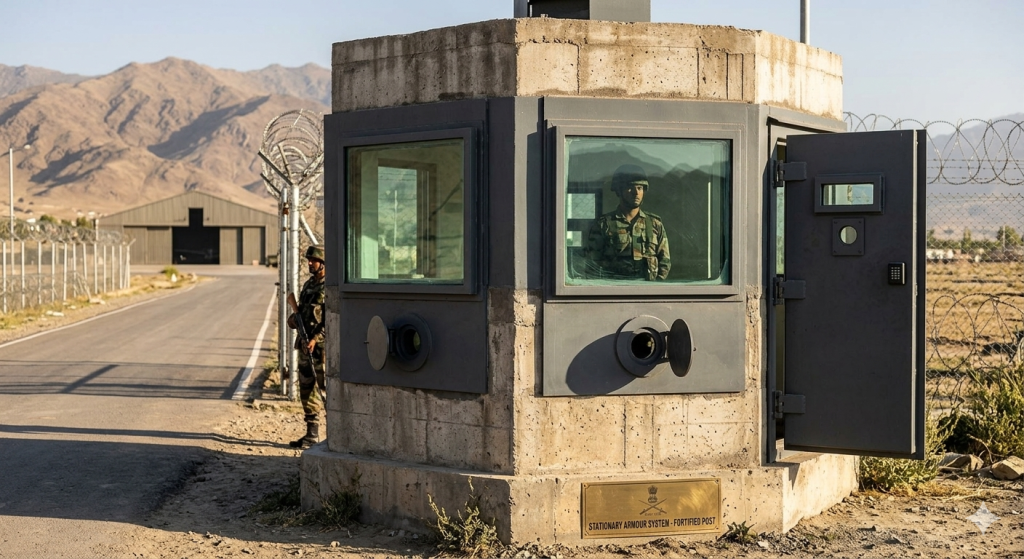
Fortified guard posts and sentry structures: Another common category of stationary armour systems includes fortified guard posts, observation bunkers, and sentry cabins.
These structures are typically deployed at:
- Border observation points
- Ammunition depots
- Airbases
- Strategic infrastructure installations
Unlike portable shields, these systems are often permanent or semi-permanent structures integrated into security infrastructure. Their construction usually combines reinforced concrete, armour-grade steel, and ballistic protection panels, enabling them to withstand sustained small-arms fire including 7.62 mm armour-piercing rounds.
Such installations allow personnel to maintain defensive positions while remaining protected from direct ballistic threats.
Modular ballistic barrier systems: Security forces often require protective systems that can be rapidly deployed in temporary or evolving operational environments. Modular ballistic barrier systems are designed to meet this requirement. These systems consist of prefabricated armour panels that can be quickly assembled to create protective walls or perimeter barriers around forward operating bases, checkpoints, and temporary camps.
The modular architecture allows security forces to scale protection based on mission requirements. For example, additional panels can be added to reinforce high-risk sections of a perimeter. This kind of flexibility has made modular ballistic systems an important component of modern defence infrastructure planning.
Observation and sniper protection systems: In surveillance-intensive operations, personnel often operate from armoured observation or sniper posts. These structures are designed with narrow firing apertures and reinforced protection panels that allow soldiers to observe and engage potential threats while minimising exposure.
Such systems, typically designed to meet NIJ Level III or III+ protection standards, are commonly deployed in counter-insurgency operations and border surveillance roles, where maintaining a concealed yet protected vantage point is essential.
Transparent ballistic protection systems: Widely used in high-traffic civilian-security environments such as airports, embassies, and government facilities, transparent armour systems include ballistic guard cabins, bullet-resistant windows, and protective glass shields. Security personnel operating in these environments often require protection systems that maintain visibility and communication with civilians.
Applications include:
- Ballistic guard cabins
- Bullet-resistant observation windows
- Protected control room panels
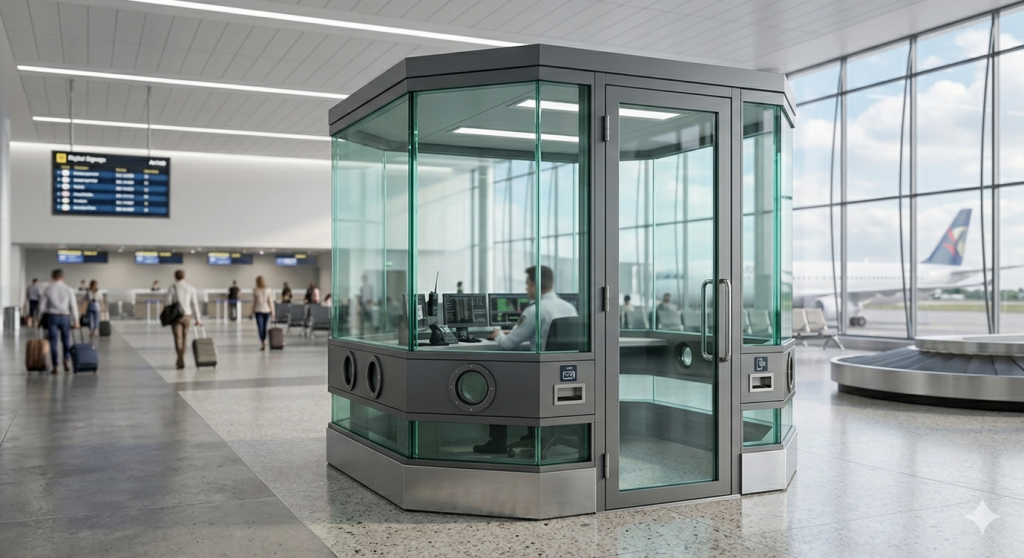
These systems combine specialised glass, polycarbonate, and polymer layers, typically providing protection at the NIJ IIIA to III levels. This allows security personnel to maintain situational awareness and interaction with the public.
Heavy fixed armour for strategic installations: Critical national infrastructure such as nuclear facilities, command centres, and high-value military installations require reinforced armour solutions designed to withstand sustained ballistic threats. These installations often combine multiple protective materials and structural reinforcements to achieve higher levels of durability.
As operational threats evolve—from small-arms fire to armour-piercing ammunition—traditional materials alone are often insufficient to deliver the required balance between protection, weight, and maintainability. This is driving a transition toward advanced engineered materials in modern stationary armour design.
Advanced materials transforming stationary armour systems
Historically, most stationary armour systems relied heavily on thick steel plates for ballistic protection. While effective, steel-based armour often results in heavy structures that can be difficult to transport, install, or modify. They could also result in injury to personnel when a projectile hits the steel barrier.
Recent advances in materials engineering have enabled the development of multi-layer armour architectures that combine several materials with complementary properties. Materials science leaders such as CUMI are developing a library of materials and applications for defence to leverage their benefits across the board – from bulletproof jackets, armoured vehicles, stationary armour systems, infrastructure armour to armour for helicopters and vulnerable areas in naval vessels.
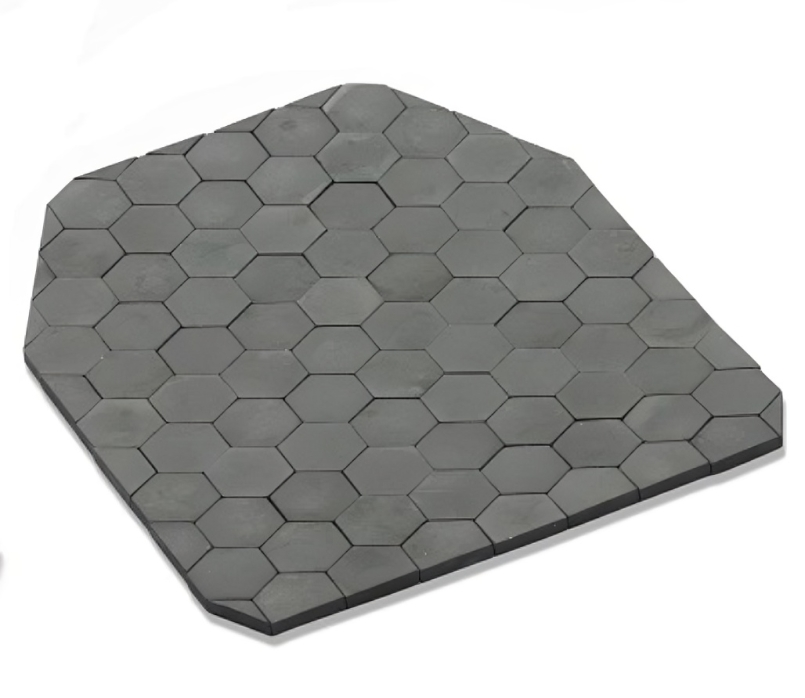
Engineered technical ceramics: Advanced ceramic materials such as alumina, silicon carbide, and boron carbide are widely used in modern ballistic protection systems. These materials are extremely hard and possess excellent compressive strength. When struck by a projectile, ceramics break and erode the projectile, significantly reducing its penetration capability.
With our 70-year expertise in advanced materials, our R&D team at CUMI has been able to perfect the powder to product process for armour ceramics. These certified tiles and patented rubber-backed panels can team up with a host of composite backing materials designed to offer protection from a range of diverse threats. Integrated into bulletproof jackets and on combat vehicles as add-on armour, they are almost 40% lighter than steel, certified as per STANAG, NIJ and BIS protection standards, and perform reliably in some of the most extreme environments. Since they are easily customisable, we have been able to adapt them for a variety of protection applications on land, water, and air, including stationary armour systems and infrastructure armour.
High-performance composite materials: Composite materials play a crucial role in modern armour design. Materials such as ultra-high-molecular-weight polyethylene (UHMWPE) and fibre-reinforced polymers are widely used as backing layers in armour systems.
These materials absorb the residual energy from projectiles that have been fractured by ceramic strike faces. Their high strength-to-weight ratio also enables designers to create protection systems that are lighter yet equally effective compared with traditional steel armour. We work in collaboration with DRDO and defence manufacturers to forward-integrate our armour ceramics with a range of composite backing materials, also ensuring they are tested and certified.
Transparent armour laminates: Multi-layer transparent armour systems combine specialised glass, polycarbonate, and polymer interlayers to achieve ballistic resistance without compromising visibility. These materials are widely used in guard cabins, control points, and observation windows.
Together, we work with a library of advanced materials to enable multi-layer armour architectures that combine hardness, toughness, and energy absorption to counter a wide range of ballistic threats.
FAST FACT
How modern ceramic armour stops a bullet
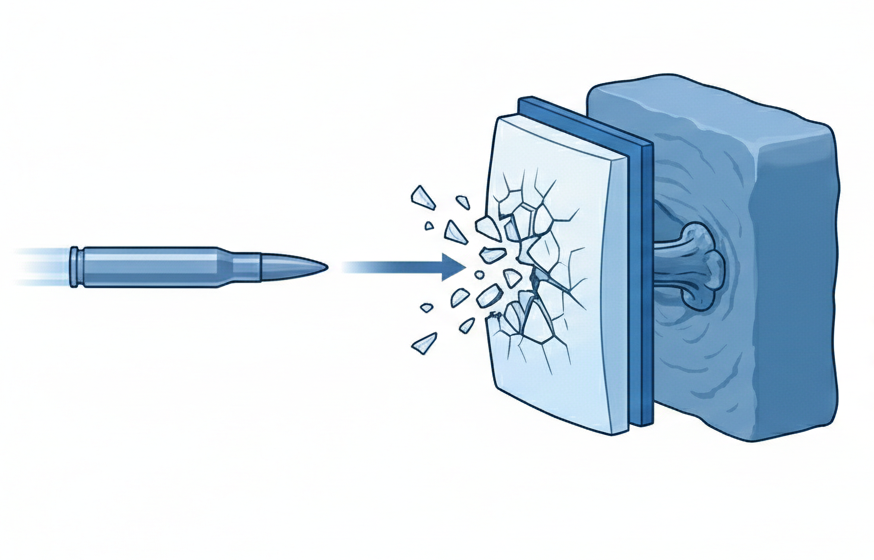
Advanced ceramic tiles paired with suitable backing materials are preferred in modern armour architectures because they employ a process described as ‘projectile defeat mechanics’ in ballistics armour engineering. When a projectile strikes the armour, the protection system works through a multi-layer energy dissipation mechanism. The outer strike-face, made of ceramic tiles, fractures or deforms the projectile on impact. Beneath this, composite backing layers absorb and spread the remaining kinetic energy across a wider area, preventing penetration of shattered fragments and reducing blunt-force trauma. This layered approach allows armour systems to defeat high-velocity threats while maintaining structural integrity.
Performance advantages of next-gen armour materials
The transition from traditional armour materials to advanced multi-material systems offers several significant operational advantages.
- Enhanced ballistic protection: Ceramic strike faces fracture incoming projectiles, while composite backings absorb residual energy. Such a layered design dramatically improves the ability of armour systems to definitively defeat ballistic threats.
- Reduced structural weight: Ceramic and composite materials offer significantly higher strength-to-weight ratios compared with steel, enabling lighter protection systems without compromising safety.
- Faster installation and deployment: Modular armour systems constructed from advanced materials are easier to transport and install, making them particularly useful for temporary security installations.
- Modular repair and maintenance: Modern ceramic armour systems often use tile-based modular designs, allowing damaged sections to be replaced individually rather than replacing entire armour panels. This improves operational efficiency and reduces maintenance costs.
Employing advanced materials to safeguard India’s security personnel
India maintains one of the largest security forces in the world, responsible for protecting national borders, strategic infrastructure, and civilian populations.
According to government data cited in the media, the Indian Army has roughly 1.2 million active personnel, making it one of the world’s largest standing armies. In addition, India’s Central Armed Police Forces (CAPFs), which include the Central Reserve Police Force, Border Security Force, and Central Industrial Security Force and operate under the Ministry of Home Affairs (India), collectively comprise close to one million personnel deployed across the country.
These forces operate in environments where ballistic threats remain a constant concern. As India continues to strengthen its defence and internal security infrastructure, advanced stationary armour systems will remain central to safeguarding the personnel who stand at the front lines of national security.
The future of stationary armour systems
As India’s defence and internal security infrastructure evolves, stationary armour systems are expected to become increasingly sophisticated and adaptable.
Governments around the world, including India, are investing in integrated border management systems, smart surveillance infrastructure, and fortified security installations. Programmes led by the Ministry of Home Affairs and the Ministry of Defence are strengthening security infrastructure across India’s borders and critical installations through initiatives such as the Border Infrastructure and Management Scheme and technology-enabled border surveillance systems.
All these measures are cohesively driving demand for advanced protective structures that combine ballistic protection with modular, rapidly deployable designs. In parallel, advances in materials science, armour engineering, and modular defence architecture are enabling stationary protection systems that are lighter, more durable, highly adaptable, and easier to maintain.
The integration of engineered ceramics, high-performance composites, and multi-layer transparent armour is allowing OEMs to build protection systems that can withstand increasingly complex ballistic threats while maintaining operational flexibility. Such integration through advanced armour design principles is expected to play a central role in designing the next generation of stationary protection systems.
